Kathryn Hahn has spent years building one of the most admired careers in modern film and television, moving easily between comedy, drama, and prestige streaming projects. Northwestern’s alumni materials describe both Hahn and her husband, Ethan Sandler, as longtime creative partners whose work spans titles such as WandaVision, Private Life, New Girl, and Meet the Robinsons. Public attention has only intensified around Hahn in recent years, especially after WandaVision and Agatha All Along.
That visibility naturally leads to curiosity about her family, especially her son, Leonard Sandler. But the public record on Leonard is narrow by design. The clearest verifiable facts are simple: he is one of Kathryn Hahn and Ethan Sandler’s two children, he grew up largely outside the spotlight, and the family has only occasionally appeared together at public events. That limited footprint is not a gap to be filled with rumor. It is part of the story itself.
Quick Bio of Leonard Sandler
| Field | Verified public detail |
|---|---|
| Full name | Leonard Sandler; E! has also referred to him as Leonard Henry. |
| Relationship | Son of actress Kathryn Hahn and writer-producer-actor Ethan Sandler. |
| Public profile | Private individual with only occasional family red-carpet appearances in public photo archives. |
| Age | Mainstream entertainment coverage described him as a teenager in 2024; the family does not make his exact age a public centerpiece. |
| Residence | Kathryn Hahn was described by Northwestern Magazine in 2011 as living in Los Angeles with Ethan Sandler and their children, Leonard and Mae. |
| Children | No public reporting indicates that Leonard Sandler has children. |
| Known philanthropic interests | No Leonard-specific philanthropic profile is publicly documented in the mainstream sources reviewed; the visible advocacy in the family’s public footprint comes through Kathryn Hahn’s support for Planned Parenthood, LGBTQ+ equality, and rescue-animal awareness. |
| Social media presence | No verified public profile is highlighted in the mainstream sources reviewed for this draft. |
| Net worth | No reliable public source provides a verifiable net worth figure for Leonard Sandler. |
| Salary / finance | No credible public reporting details personal earnings, salary, businesses, or asset disclosures for Leonard Sandler. |
Who Is Leonard Sandler?

Leonard Sandler is best understood not as a celebrity in his own right, but as the son of two working figures in the entertainment industry who have largely kept their home life separate from the machinery of fame. Public sources identify him as the son of Kathryn Hahn and Ethan Sandler and the brother of Mae Sandler. Northwestern Magazine referenced Leonard and Mae as the couple’s “two young children” in 2011, while E! described them as teenagers in 2024, showing how little of Leonard’s life has been publicly narrated beyond broad family context.
That makes Leonard Sandler significant in a different way. His public profile illustrates how some celebrity families resist the usual cycle of exposure. Instead of turning children into extensions of a brand, Hahn and Sandler have allowed only brief, controlled glimpses of family life: the odd premiere, a passing anecdote in an interview, a family movie night mentioned in conversation. The result is a rare thing in celebrity culture: a child of famous parents who remains mostly known through absence rather than overexposure.
A Childhood Kept Deliberately Offstage
The strongest fact about Leonard Sandler’s early life is how little of it was commercialized. There are no substantial magazine profiles, no regular social-media showcases, and no public-facing effort to build a celebrity-child identity around him. That restraint aligns with Hahn’s broader comments about family life. In a 2018 interview excerpted by Parade, she said she had a “rich and creative life” and also a “normal life,” and that she had tried to keep the two “separate and holy.” That sentence is one of the clearest keys to understanding why Leonard’s public biography is so thin.
The scarcity of detail is not evidence of mystery. It is evidence of boundary-setting. In a media culture that rewards constant access, the Sandler-Hahn family appears to have chosen selectivity instead. Leonard Sandler’s early life, in other words, is not publicly important because of dramatic revelations; it is important because it shows what it looks like when public parents refuse to turn childhood into content. That conclusion is an inference from the pattern of reporting, not a claim about private motives.
What Public Appearances Actually Show
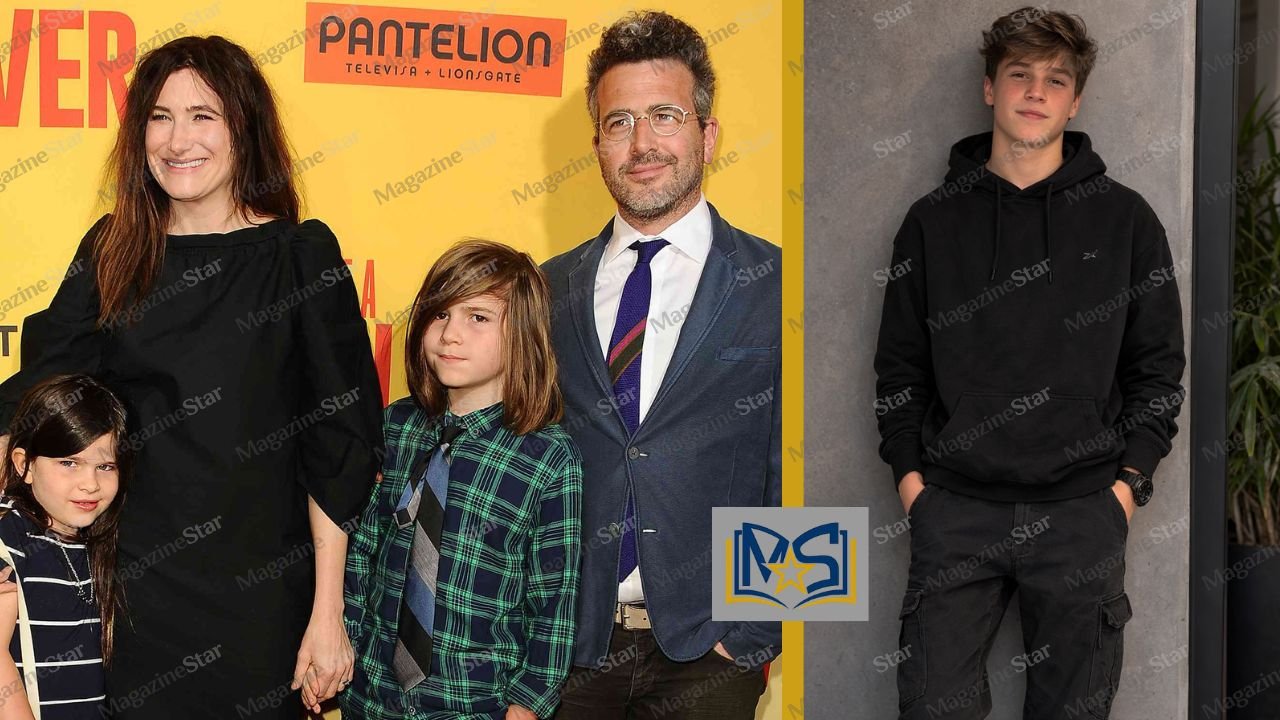
When Leonard Sandler does surface in the public record, it is usually through photo-agency documentation of family premieres. Getty Images records the family at The Boxtrolls premiere in 2014, the Tomorrowland premiere in 2015, and the How to Be a Latin Lover premiere in 2017. Those appearances matter because they are among the few clean, verifiable data points available. They confirm family structure and show that Leonard was occasionally included in age-appropriate, family-oriented public events.
Just as important is what those appearances do not show. They do not reveal a public career, media strategy, or effort to make Leonard a recurring figure in celebrity coverage. They read more like family outings than a calculated expansion of brand identity. That distinction matters when writing about Leonard Sandler, Kathryn Hahn’s son: the historical record supports occasional visibility, not celebrity status.
The Household and Values Around Him
Any responsible account of Leonard Sandler has to look at the household around him. Kathryn Hahn and Ethan Sandler met at Northwestern, built careers in overlapping parts of entertainment, and have remained publicly associated as a long-running creative and personal partnership. Northwestern’s alumni podcast frames them as a “power couple,” while E! reported in 2025 that Hahn described their relationship as one that has weathered many seasons since their 2002 marriage.
That kind of long-duration partnership shapes a family culture, even when the family keeps its details private. Publicly, the image is less about glamour than steadiness: two industry veterans, both working, both experienced in creative life, and neither particularly interested in public oversharing. Leonard’s role “behind the scenes,” then, can only be described cautiously. What can be said is that he grew up in a home where storytelling was the family trade, but private life was still treated as something worth protecting.
Family Life and the Culture of Parenting
Hahn’s interviews offer the best available window into the values of the home Leonard grew up in. In her 2016 TIME interview, she spoke about the pressure mothers place on themselves and described her happiest parenting moments not in terms of achievement, but in seeing her children treat other people kindly. That is not a biography of Leonard, but it is a meaningful clue to the ethic the family has discussed publicly: kindness over polish, humanity over performance.
A 2021 conversation in The Cut and a 2024 E! interview add a second layer. Hahn talked in The Cut about the strange speed of children growing up, while E! reported that the family watched WandaVision together and that Leonard and Mae were excited by seeing the story unfold without spoilers. Those are small details, but they matter because they show family life as shared experience rather than publicity. Leonard enters the public record not as a character in a narrative machine, but as a son in a family that sometimes watches Mom’s work together at home.
Philanthropy and the Family’s Public Footprint
There is no substantial public record of Leonard Sandler operating as an individual philanthropist, spokesperson, or activist. The visible charitable footprint belongs to Kathryn Hahn. The Human Rights Campaign announced in 2016 that it would honor her with its “Ally for Equality” Award, and Planned Parenthood Advocates of Ohio described her as a longtime supporter who returned to Cleveland to help a get-out-the-vote effort focused on reproductive rights. In 2024, The Dodo also featured Hahn in a rescue-animal segment centered on adoptable pets.
That distinction is worth making clearly. It would be inaccurate to project Kathryn Hahn’s public advocacy directly onto Leonard Sandler as if it were his documented platform. What can be said, more carefully, is that Leonard grew up in a family whose public-facing values have included equality advocacy, reproductive-rights support, and compassion toward rescue animals. The public evidence supports a household exposed to civic-minded causes, not a personal activist biography for Leonard himself.
The Power of Privacy: Influence Without Publicity
Privacy is often mistaken for emptiness in celebrity coverage. In Leonard Sandler’s case, privacy is the defining fact. Hahn’s own public language supports that reading: she has spoken about keeping creative life and normal life separate, and in a 2015 People interview she praised Jennifer Aniston and Justin Theroux for preserving the privacy they wanted around their wedding. Even though that remark was about someone else, it fits a broader pattern in Hahn’s public posture: privacy is not a nuisance to her, but something worthy of respect.
That is why Leonard Sandler’s limited visibility can be read as meaningful rather than incomplete. In a digital culture that often treats famous families as open-access material, a mostly private upbringing becomes its own quiet statement. It suggests that influence does not always require publicity, and that a child can belong to a famous family without being turned into a public product. That is an inference from the documented pattern, but it is a grounded one.
Leonard Sandler Net Worth: What Can Be Said Responsibly?
This is the section where many celebrity-family articles go wrong. A search engine may tempt writers to attach a number to Leonard Sandler’s “net worth,” “salary,” “finance,” or “assets,” but there is no reliable public reporting that would justify an exact figure. Leonard is a private individual, not a public executive, not a credited entertainment figure with a known compensation trail, and not the subject of any credible financial disclosure in the mainstream sources reviewed here. Because of that, any article presenting a precise dollar estimate would be performing confidence, not reporting.
A trustworthy financial snapshot therefore has to be a verification table, not a fantasy number:
| Financial item | Publicly verified? | Responsible takeaway |
|---|---|---|
| Personal net worth | No | No credible mainstream source establishes a figure. |
| Salary / wages | No | No public employer, role, or compensation record is documented. |
| Business holdings | No | No reliable reporting identifies businesses or asset ownership under Leonard’s public profile. |
| Family wealth | Partly, but not attributable | His parents have established entertainment careers, but that does not equal a reportable personal net worth for Leonard. |
The broader lesson is important for readers and publishers alike. “Net worth” content often ranks well in search, but the ranking incentive is exactly why it becomes unreliable around private people. In Leonard Sandler’s case, the honest answer is that no verified public number exists. That is not a weakness in the record. It is the strongest available evidence that financial claims about him should be treated skeptically unless they come from documented filings, direct interviews, or similarly high-grade sources. For a private person, restraint is more accurate than precision.
Public Curiosity, Search-Engine Myths, and Misconceptions
Public curiosity about Leonard Sandler is understandable. Kathryn Hahn is a high-profile actor, and audiences often assume that the family lives of recognizable performers must also be public property. The problem is that search ecosystems reward overconfident summaries. Many pages online package celebrity relatives into neat biographical boxes filled with dates, earnings, and personality claims that are more granular than the public record supports. By contrast, the strongest mainstream evidence on Leonard remains modest: family relationship, a handful of appearances, and occasional comments from Hahn about parenting.
That gap between curiosity and proof is where misconceptions flourish. A trustworthy article about Leonard Sandler should not compete with gossip blogs by pretending access it does not have. It should do the opposite: narrow the story to what is verifiable and explain why the boundary exists. In that sense, the real correction is methodological. Leonard Sandler is not poorly documented because the facts are hidden in some dramatic way; he is lightly documented because his family has mostly kept ordinary life outside public consumption.
Legacy and Future
It is too early, and too unsupported, to assign Leonard Sandler a public legacy of his own. No credible reporting suggests a chosen profession, public platform, or entertainment career trajectory. What can be said is narrower and, in a way, more revealing: Leonard belongs to a celebrity family that has managed to preserve a meaningful line between professional visibility and personal life. That in itself is unusual enough to matter.
His future may remain private, and that would be fully consistent with the public pattern so far. If Leonard Sandler eventually steps into a creative field, civic role, or public profession, the story will expand on its own terms. Until then, the most honest legacy-based reading is this: he represents a rare example of a famous family choosing stewardship over exposure.
Conclusion
Leonard Sandler, Kathryn Hahn’s son, occupies an unusual place in celebrity culture. He is publicly recognizable by connection, but not publicly defined by performance. Verified reporting shows a son of Kathryn Hahn and Ethan Sandler who grew up in Los Angeles, appeared occasionally at family-friendly premieres, and remained largely outside the promotional economy that swallows many celebrity relatives.
That does not make his story thin. It makes it disciplined. The public record around Leonard Sandler is a case study in privacy, family boundaries, and the difference between attention and knowledge. In an era that rewards oversharing, the most accurate conclusion is also the simplest: Leonard’s role in public life has been quiet, limited, and carefully protected, and that quiet may be the most revealing fact of all.
Also Read About The Untold Truth About Joni Ernst’s Ex-Husband
FAQs About Leonard Sandler
1. Who is Leonard Sandler?
Leonard Sandler is publicly identified as the son of actress Kathryn Hahn and writer-producer-actor Ethan Sandler. (E! Online)
2. Is Leonard Sandler a public celebrity?
Not in the usual sense. Public archives show only occasional family-event appearances, not an independent public career. (gettyimages.ca)
3. Does Leonard Sandler have siblings?
Yes. Public sources identify Mae Sandler as his sister.
4. Where did Leonard Sandler grow up?
Northwestern Magazine described Kathryn Hahn as living in Los Angeles with Ethan Sandler and their children, Leonard and Mae, in 2011. (northwestern.edu)
5. Has Leonard Sandler appeared with Kathryn Hahn in public?
Yes. Getty and FilmMagic archives place the family at premieres including The Boxtrolls, Tomorrowland, and How to Be a Latin Lover.
6. What is Leonard Sandler’s net worth?
No reliable public source provides a verified net worth figure for Leonard Sandler.
7. Is Leonard Sandler involved in philanthropy?
There is no substantial Leonard-specific public philanthropy profile. The public advocacy attached to the family name comes through Kathryn Hahn’s work with groups such as the Human Rights Campaign and Planned Parenthood-related efforts. (Human Rights Campaign)
8. Why is so little known about Leonard Sandler?
The public pattern suggests deliberate family privacy. Kathryn Hahn has explicitly spoken about keeping her creative and normal life separate. (Parade)