
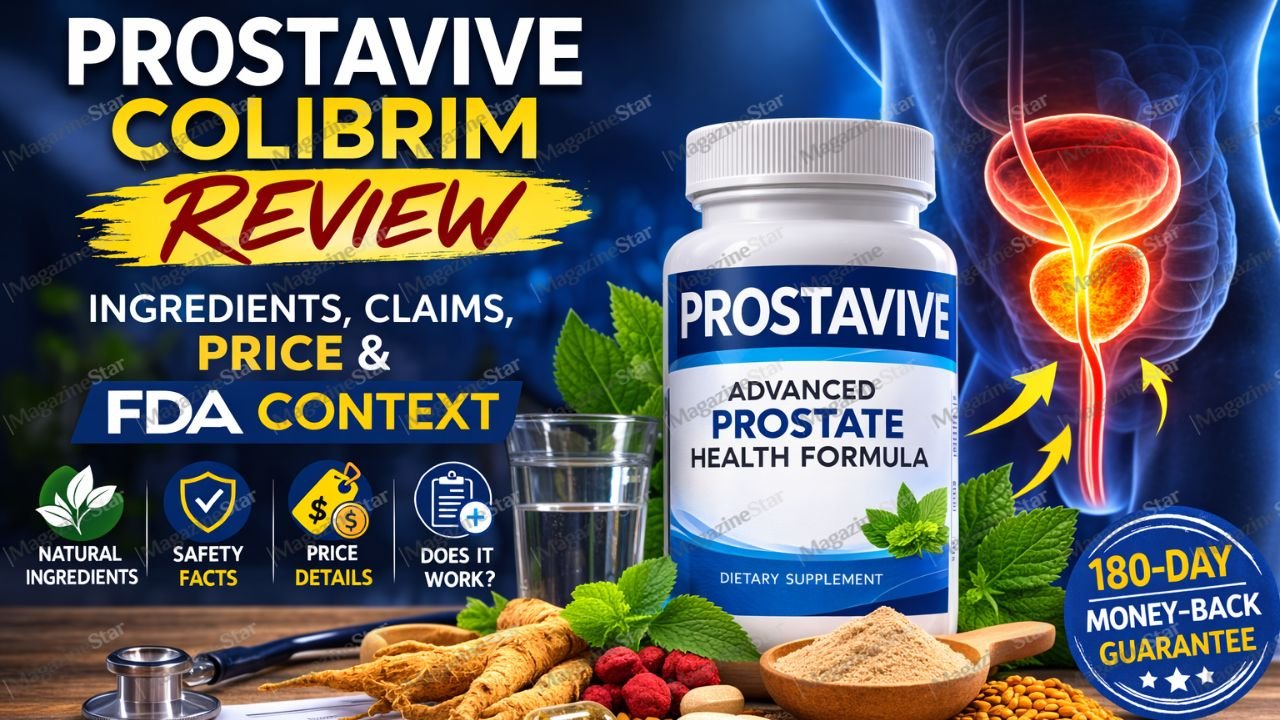
Medical & Editorial Disclaimer This article is published for informational and consumer awareness purposes only. It does not constitute medical advice, diagnosis, or treatment. Prostate health conditions — including BPH, prostatitis, or prostate cancer — require evaluation by a qualified physician or urologist. Always consult a licensed healthcare provider before starting any dietary supplement. Magazineshi.com may earn an affiliate commission from product links on this page.
ProstaVive & the “Colibrim” Search Trend: An Independent Ingredient Analysis and Consumer Guide
“Every week, thousands of men over 40 search the internet for relief from prostate-related discomfort — and every week, they wade through an ocean of affiliate content trying to find something honest.”
If you’ve been researching prostate health and found yourself repeatedly encountering the term “ProstaVive Colibrim” in your search results, you’re not alone. It’s one of the most searched-for supplement combinations on Google in the men’s health category right now. But what does it actually mean? Is the product legitimate? And does the science behind its ingredients hold up?
I spent time pulling apart the ingredient profile, cross-referencing it against independent clinical research, and analyzing the online ecosystem around this product. What follows is not a promotional piece. There are enough of those on the first page of Google already. This is an attempt to give you the factual, objective picture — so you can make a decision that’s right for your health, not someone else’s commission.
What is ProstaVive, and What is the “Colibrim” Search Trend?
ProstaVive is a dietary supplement marketed primarily at men over 40, positioned as a natural support formula for prostate health. Its primary marketing claims center on reducing urinary frequency, supporting healthy urine flow, and contributing to overall male hormonal balance. It is sold predominantly online, direct-to-consumer, with packages ranging from a single bottle to multi-month supplies.
Now, what about the word “Colibrim” that appears next to it everywhere? This is worth explaining clearly, because it confuses a lot of people.
The “Colibrim” Marketing Footprint Explained
“Colibrim” appears to be a domain or network name associated with a supplement affiliate review ecosystem — essentially, a large network of review-style websites and content properties that publish articles about multiple supplements under the same umbrella. When you see “ProstaVive Colibrim” trending as a search phrase, it means a significant volume of people are either visiting sites in that network or searching specifically to find their reviews of ProstaVive.
This is a common structure in the dietary supplement industry. Affiliate networks build review sites, target product-specific keywords, and earn commissions when readers click through and purchase. The term “Colibrim” is, in other words, a marketing footprint — not a product feature, not an ingredient, and not an independent certification. Understanding this is the first step in evaluating any prostate health supplements review you encounter that carries this label.
When searching for independent supplement reviews, look for disclosures at the top of the article, not buried in the footer. A legitimate review will tell you upfront whether the author earns a commission. The absence of any disclosure is itself informative.
Deep Dive: Analyzing the Claimed Ingredients
The most useful thing I can do for you here is not tell you whether ProstaVive “works.” I can’t make that determination, and neither can any review site — clinical outcomes for individuals vary enormously. What I can do is look at the category of ingredients this supplement is commonly marketed as containing and tell you what the independent scientific literature actually says about each one.
These are the five core ingredients most prominently featured in ProstaVive’s marketing materials:
Saw Palmetto (Serenoa repens)
Evidence: Mixed
Saw palmetto is arguably the most studied botanical for prostate support and the most commonly found ingredient in male supplements of this category. It is hypothesized to work by inhibiting 5-alpha reductase, the enzyme that converts testosterone to dihydrotestosterone (DHT) — elevated DHT being associated with benign prostatic hyperplasia (BPH).
The clinical evidence, however, is genuinely mixed. A landmark 2006 trial published in the New England Journal of Medicine (Bent et al.) found saw palmetto extract no more effective than placebo for BPH symptoms. A 2012 dose-escalation trial produced the same finding. On the other side, several European studies and a 2009 Cochrane review analysis have found modest improvements in urinary flow metrics. The scientific consensus at this point is: saw palmetto is unlikely to cause harm at standard doses, but its efficacy for prostate symptom relief is not conclusively established.
Zinc
Evidence: Reasonably Strong
The prostate gland contains a higher concentration of zinc than virtually any other tissue in the human body. Research consistently shows that zinc levels are significantly lower in prostate cancer tissue compared to healthy prostate tissue, and zinc deficiency is associated with impaired immune function and increased oxidative stress. As a zinc supplement for general prostate support, the evidence base here is more solid than for most botanicals in this category — though it’s worth noting that supplementing zinc in men who are already sufficient offers marginal benefit and excess zinc supplementation can interfere with copper absorption. Getting zinc levels checked before supplementing is sensible.
Magnesium
Evidence: Reasonably Strong (General)
Magnesium is an essential mineral involved in over 300 enzymatic processes in the body, including those governing muscle function, nerve transmission, and inflammation regulation. Its direct relationship to prostate health specifically is less established than zinc’s — but its role in reducing systemic inflammation, supporting testosterone metabolism, and contributing to better sleep quality makes it a reasonable inclusion in a general men’s health formula. Magnesium supplements are among the safest and most evidence-backed nutritional interventions across men’s health broadly. Deficiency in magnesium is extremely common in Western diets, which means supplementation often addresses a genuine gap.
Ashwagandha (Withania somnifera)
Evidence: Mixed but Promising
Ashwagandha is an adaptogenic herb with a long history in Ayurvedic medicine. Its relevance to a prostate supplement lies primarily in its documented effects on cortisol reduction and testosterone support rather than direct prostate tissue effects. Several double-blind, placebo-controlled trials have found significant reductions in serum cortisol levels and modest but statistically significant increases in testosterone in men taking standardized ashwagandha extract (KSM-66 or Sensoril forms). High chronic stress and elevated cortisol are associated with hormonal imbalance that can indirectly affect prostate health. The ashwagandha inclusion makes more mechanistic sense for a stress and hormonal support angle than as a direct prostate-targeting agent.
Boron
Evidence: Limited but Interesting
Boron is a trace mineral receiving increasing attention in the supplement research community. A notable 2004 study and subsequent epidemiological analyses found an inverse relationship between dietary boron intake and prostate cancer risk. Some research suggests boron may inhibit certain prostate-specific enzymatic activity. However, the evidence base here is limited in scope — most findings come from observational or in-vitro studies rather than large-scale randomized controlled trials. It is a genuinely interesting inclusion from a scientific standpoint, but one that should be framed as “emerging” rather than established.
A note on dosages: the clinical efficacy of any supplement ingredient is highly dose-dependent. Many supplement products include ingredients at doses far below what was used in the studies cited in their marketing. This is a critical point for any prostate supplement — always look for the supplement facts panel and compare doses to clinical trial quantities before purchasing.
What the Ingredient Profile Tells Us Overall
Taken together, the ingredient profile marketed for ProstaVive is not unusual or unreasonable for its category. The combination of a prostate-targeting botanical (saw palmetto), essential minerals with documented prostate relevance (zinc, magnesium), a hormonal/stress adaptogen (ashwagandha), and an emerging trace mineral (boron) represents a fairly typical formulation for premium male health supplements. The honest assessment is: some ingredients have meaningful evidence, some have mixed or limited evidence, and none are clinically proven to treat prostate disease.
The Reality of Online Supplement Reviews and the Search for Genuine Feedback
If you’ve been trying to find truly independent supplement reviews, you’ve likely noticed something frustrating: the first several pages of Google results for almost any supplement are dominated by affiliate review sites — many of which are designed to look like independent consumer guides but are actually thinly-veiled sales pages.
How to Distinguish Genuine Reviews from Affiliate Content
Here is a practical checklist, drawn from how misinformation researchers and consumer protection bodies evaluate supplement review credibility:
Affiliate disclosure placement. Legitimate review sites disclose their financial relationships at the top of the article, in plain language. If a disclosure exists only in a tiny footer note, that’s a red flag. The FTC requires prominent disclosure in the United States.
Balanced negative information. Real reviews include substantive cons, mention scientific limitations, and acknowledge where evidence is weak. If a review mentions only positive outcomes and frames every potential concern as minor or irrelevant, it is almost certainly written to convert readers, not inform them.
Author credentials and verifiability. Does the stated author have a verifiable professional presence? Can you find them on LinkedIn, in published research, or in a professional directory? Ghost-written content under invented personas is common in the supplement affiliate space.
Where user testimonials come from. Testimonials on a product’s own website or on affiliate review sites are not independent user data. For genuine user sentiment, look at third-party platforms with verified purchase reviews, community forums like Reddit’s r/Supplements, or academic consumer research.
Potential Side Effects and Safety Considerations
Looking at the ingredient profile for prostate supplements in this category, here is objective supplement side effects information based on the known profiles of these botanicals and minerals:
Saw palmetto is generally well-tolerated at standard doses (160–320mg). The most commonly reported adverse effects are mild gastrointestinal symptoms — nausea, stomach discomfort, or diarrhea — particularly when taken without food. Rare cases of liver-related issues have been reported in the literature, though causality is not established. Men on blood thinners should exercise caution.
Zinc at doses above 40mg daily can cause nausea and can deplete copper over time. Most prostate supplements use 10–30mg per serving, within safe limits for most adults.
Magnesium supplementation at high doses can cause loose stools or diarrhea — this is dose-dependent and typically resolves by lowering the dose. Magnesium glycinate and citrate forms tend to be better tolerated than magnesium oxide.
Ashwagandha is generally well-tolerated in standardized extract form. Rare reports exist of liver enzyme elevations at very high doses. It may interact with thyroid medications and immunosuppressants. Not recommended during pregnancy.
Boron at typical supplement doses (3–10mg) is considered safe. Very high doses (well above supplement range) can cause toxicity, but this is not a concern at normal supplementation levels.
Importantly, men with diagnosed prostate conditions — particularly those undergoing treatment for prostate cancer or BPH — should not use any supplement without explicit guidance from their urologist, as some herbal ingredients may interfere with medications or diagnostic markers like PSA levels.
Pros and Cons: An Objective Assessment
Potential Positives
- Ingredient profile follows established formulation patterns for men’s prostate supplements
- Zinc and magnesium inclusions address documented common deficiencies in men over 40
- Ashwagandha has solid evidence for stress/cortisol reduction, a real men’s health issue
- Multi-bottle purchases typically come with a money-back guarantee
- No prescription required; accessible as a starting point for men not yet ready for a clinical visit
- Contains no known dangerous compounds at labeled doses
Honest Limitations
- Saw palmetto evidence is genuinely mixed — major RCTs have found no benefit over placebo
- Proprietary formulas make it impossible to verify dosages against clinical trial quantities
- Not FDA-approved and not evaluated for efficacy as a medical treatment
- Premium pricing compared to purchasing individual ingredients separately
- Online review ecosystem is heavily affiliate-driven — independent verification is difficult
- Cannot diagnose, treat, or cure any prostate condition
Pricing, Safety, and Where to Buy
ProstaVive follows a pricing model standard to the direct-to-consumer supplement industry, with strong incentives built in for multi-bottle purchases. Based on publicly available pricing at time of writing:
| Package / Supply | Price Per Bottle | Remarks |
| 1 Bottle (30 Days) | ~$69 | Standard |
| 3 Bottles (90 Days) | ~$59 | Most Popular |
| 6 Bottles (180 Days) | ~$49 | Best Value |
Counterfeit Product Warning Supplements sold through Amazon, eBay, or unofficial third-party sellers claiming to offer “ProstaVive” at heavily discounted prices are a known fraud vector. Counterfeit or adulterated supplement products have been documented across the industry, and purchasing through unofficial channels also typically voids any money-back guarantee. If you decide to purchase ProstaVive after consulting your physician, buy exclusively from the official ProstaVive website to ensure product authenticity and refund eligibility.
When researching the prostavive official website through the Colibrim-associated search footprint, you’ll find multiple redirecting affiliate links. The safest approach is to navigate directly to the manufacturer’s domain rather than clicking through an aggregator link, to ensure you’re purchasing the authentic product at the actual current price.
Frequently Asked Questions
Is ProstaVive FDA-approved?
No — and this is not unique to ProstaVive. Dietary supplements in the United States are not required to obtain FDA approval before going to market. The FDA regulates supplements under a different framework than pharmaceuticals (DSHEA 1994). Manufacturers are responsible for ensuring their products are safe, but the FDA does not evaluate supplement efficacy claims before sale. This is why independent third-party testing (NSF, USP, or Informed Sport certification) is a meaningful quality signal when evaluating any dietary supplement.
How long does shipping take, and is there a refund policy?
Based on the standard terms associated with this product, domestic US shipping typically takes 5–7 business days. Most multi-bottle purchases include a 180-day money-back guarantee, though refund terms should always be verified directly on the official product page before purchase, as these policies can change.
Can ProstaVive interact with my existing medications?
Potentially, yes. Saw palmetto may interact with blood-thinning medications (warfarin, aspirin therapy). Ashwagandha may interact with thyroid medications and immunosuppressants. Any man currently taking prescription medications — particularly those for BPH, testosterone therapy, or any cardiovascular condition — should discuss all supplement use with their prescribing physician before starting. This is not a precautionary boilerplate; it is genuinely important.
Why does “ProstaVive Colibrim” appear so many times in search results?
As outlined earlier in this guide, “Colibrim” represents an affiliate content network that has published a high volume of review and comparison content targeting supplement keywords. When a network produces many articles around a specific term, that term begins to generate its own search volume as users who’ve seen it once search for it again. This is a common pattern in digital affiliate marketing and explains the search footprint, not any feature of the product itself. Consumers searching for truly independent prostate health supplement reviews should be aware of this dynamic.
What prostate symptoms actually warrant seeing a doctor instead of trying a supplement?
This is the most important question in this entire article. See a urologist promptly — not after trying supplements — if you experience: blood in urine or semen; pain or burning during urination; difficulty initiating urination or a very weak stream; pain in the lower back, hips, or pelvis; or any sudden change in urinary or sexual function. These can be symptoms of BPH, prostatitis, or prostate cancer, all of which require professional diagnosis and management. A supplement cannot diagnose or treat any of these conditions. The PSA (prostate-specific antigen) blood test and digital rectal exam are the standard screening tools — talk to your GP.
Final Verdict by Rehman Wada
Analyst’s Assessment
6.5/ 10
A formulaically reasonable men’s health supplement with a mixed evidence base. Zinc and magnesium inclusions are defensible; saw palmetto efficacy remains genuinely contested. Not a substitute for medical care, but not an unreasonable choice for a man who has already ruled out serious pathology and is looking for nutritional support.
After working through the ingredient science, the pricing model, and the online review landscape, here is my honest conclusion:
ProstaVive’s formulation is not unusual, not dangerous at labeled doses, and not entirely without scientific rationale. If you are a man over 40 with no diagnosed prostate condition who wants to support general prostate health through nutrition — and you have already spoken with a doctor who has ruled out anything requiring medical treatment — then a supplement in this category is a reasonable addition to a healthy lifestyle. Zinc and magnesium alone address real nutritional gaps common in Western diets.
What I’d push back on firmly is the marketing ecosystem around it. The “Colibrim” search footprint represents an affiliate review architecture, not an independent research community. Prostate health supplement reviews produced within affiliate networks carry an inherent conflict of interest, and consumers should weigh them accordingly.
Most importantly: if you have active symptoms — urinary urgency, reduced flow, pelvic pain, or anything that has changed — please see a urologist before spending money on any supplement. Prostate cancer is the most commonly diagnosed cancer in men. Early detection changes outcomes dramatically. No supplement, however well formulated, changes that calculus.
A supplement can be a reasonable part of a wellness routine. It cannot be a substitute for a diagnosis.
About the author: Rehman Wada is a health and wellness journalist writing for Magazineshi.com. This article reflects independent research and analysis. Magazineshi.com may earn affiliate commissions from links on this page; this does not influence the editorial content or assessments above.
Sources consulted: Bent S et al., NEJM 2006; Cochrane Reviews on Serenoa repens; NIH Office of Dietary Supplements (Zinc, Magnesium fact sheets); Pizzorno L, “Nothing Boring About Boron,” Integrative Medicine 2015; Chandrasekhar K et al., IOSR Journal of Pharmacy 2012 (ashwagandha); FDA Dietary Supplement guidance documentation.
Last reviewed and updated for accuracy. This article is not a substitute for professional medical advice.


