Introduction
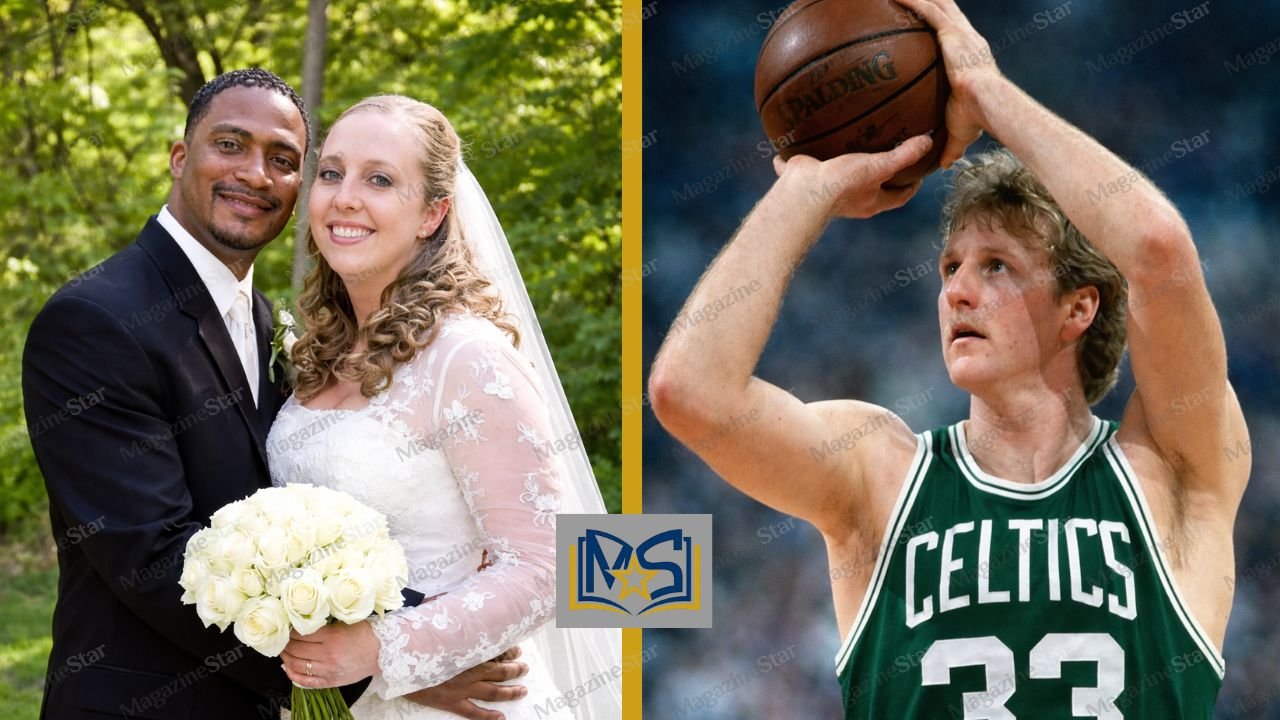
Larry Bird‘s name is etched permanently into basketball’s golden history. As a three-time NBA champion with the Boston Celtics, a two-time Finals MVP, and one of the most cerebral players the sport has ever produced, Bird transcended the game. His legend was built in arenas, but his most complex and human story unfolded in private — in the spaces between games, championships, and public adulation.
At the center of that private story is Corrie Bird, his biological daughter. Born in 1977 from a brief and troubled first marriage, Corrie has lived her entire life adjacent to one of sport’s biggest names — yet she has resolutely carved out a life that is entirely her own. She pursued education, built a career in healthcare administration, married, and raised a family. She did it without press conferences, public profiles, or celebrity status. This article draws on verified public information to explore who Corrie Bird truly is: a woman defined not by her father’s fame, but by her own quiet resilience.
Quick Bio: Corrie Bird at a Glance
| Field | Details |
|---|---|
| Full Name | Corrie Bird Batson |
| Date of Birth | August 14, 1977 |
| Place of Birth | Brazil, Indiana, USA |
| Age (as of 2025) | 47–48 years old |
| Relationship | Biological daughter of NBA legend Larry Bird |
| Mother | Janet Condra (Larry Bird’s first wife) |
| Spouse | Trent Theopolis Batson (married May 17, 2008) |
| Children | Violet Marie (born June 18, 2012), Sebastian Gray (born April 20, 2017); two stepchildren from Trent’s prior relationship |
| Education | B.S. in Elementary Education / Business Management, Indiana State University (1999); MBA, Indiana Wesleyan University |
| Career | Healthcare Administration / Management |
| Half-Siblings | Mariah Bird and Connor Bird (adopted children of Larry Bird and Dinah Mattingly) |
| Social Media Presence | Deliberately low-profile; not publicly active |
| Public Profile | Private individual; avoids media spotlight |
Who Is Corrie Bird?
Corrie Bird is the biological daughter of Larry Bird, widely regarded as one of the greatest players in NBA history, and Janet Condra, his high school sweetheart and first wife. Her parents married in November 1975 and divorced less than a year later in October 1976, before Corrie was even born. That fractured beginning set the stage for a childhood marked by emotional distance from her famous father, even as he rose to superstardom in Boston.
Despite the circumstances of her birth — a post-divorce child whose paternity was initially contested — Corrie grew up in Indiana, raised primarily by her mother, and later a stepfather. Over the decades, she pursued higher education, earned a graduate degree, built a stable professional career in healthcare, and established a family of her own. She is, in every sense, a private citizen who happens to share a last name with a sports icon. Her significance lies not in inherited fame, but in the personal strength it took to build a meaningful life in the long shadow of an absent, celebrated father.
The Private Life of Corrie Bird
One of the most defining aspects of Corrie Bird’s identity is her deliberate choice to remain outside the public eye. In an era when celebrity offspring frequently leverage their family connections for social media followings, brand deals, or entertainment careers, Corrie has chosen a fundamentally different path. She does not maintain a visible public social media presence, has not written a memoir about her complicated relationship with her father, and has not sought media attention despite the fact that her story — a daughter estranged from one of America’s most beloved athletes — would certainly attract it.
This privacy is not born of bitterness or obscurity; it is an active, principled choice. Corrie has spoken briefly in documented instances, such as her quoted reaction after attending the Indiana Pacers’ final home game of the 1997–98 season, where she expressed genuine warmth toward her father. Her restraint in public life speaks to a person who has processed a complicated inheritance and chosen to define herself on her own terms. The contrast between her father’s relentless public scrutiny throughout his playing days and her own quiet existence is stark — and clearly intentional.
The Complex Relationship Between Larry Bird and Corrie
Corrie Bird was born on August 14, 1977, in Brazil, Indiana — the same state that produced her father. Her birth came after her parents had already divorced, placing her in an unusual and emotionally fraught position from the very beginning. Larry Bird, by his own admission in his autobiography Drive: The Story of My Life, initially denied paternity. A court-ordered DNA test confirmed he was her father, and he subsequently provided financial support, though emotional presence was far scarcer.
Growing up, Corrie was raised in a single-parent household by her mother Janet, who later remarried. By all public accounts, she had a relatively normal Indiana upbringing, attending local schools and participating in sports — she was reportedly a capable basketball player in high school, a genetic inheritance she did not pursue professionally. In her youth, she made documented efforts to connect with her father, reportedly sending him letters, report cards, and photographs over the years. Many of those gestures went unanswered, a reality that Larry Bird himself acknowledged with regret in his published writing. These early years shaped in Corrie a degree of self-reliance that would define her adult choices.
The Complex Father-Daughter Relationship
The relationship between Corrie Bird and Larry Bird is perhaps the most publicly documented aspect of her life, primarily because Larry himself addressed it with unusual candor in his 1989 autobiography. “I can’t honestly say I’ve had much to do with her life because of my differences with Janet,” he wrote. “I think about Corrie all the time, but what can I really do now? I can’t go back and relive the first five or six years of her life.”
It is a remarkably honest confession from a man not known for emotional openness. Bird did not hide behind excuses; he acknowledged the loss while admitting his own limitations. He also expressed genuine admiration: “Corrie is a fine and beautiful young lady. Her mother has done a great job bringing her up in the best way possible. She’s good at everything she does, and I’m really proud of her.”
The turning point in their relationship came during the 1997–98 NBA season, when Larry was head coach of the Indiana Pacers. His wife, Dinah Mattingly, arranged for Corrie to receive tickets to the team’s final home game. The father and daughter met, talked, and Larry walked her to her car and hugged her. Corrie recalled the moment with understated hope: “Dad seemed interested in what I had to say. He walked me to my car, and he hugged me. I hope I can see more of him now.” Subsequent public records confirm that Larry attended Corrie’s graduation and her wedding — two of the most significant milestones of her adult life — suggesting a gradual, if incomplete, reconciliation built on mutual respect rather than close daily contact.
Corrie Bird’s Role Behind the Scenes
Corrie Bird occupies a quiet but meaningful role within the broader Bird family story. While she was not raised alongside Larry’s adopted children, Mariah and Connor Bird — who are from his long-term second marriage to Dinah Mattingly — she has maintained a respectful, if not deeply intimate, relationship with the wider family. The fact that Dinah Mattingly personally arranged Corrie’s tickets to that pivotal 1998 Pacers game is itself revealing. It suggests that the women in Larry Bird’s life exercised a kind of quiet diplomacy that the man himself struggled to initiate.
In a broader sense, Corrie’s role has been to absorb the consequences of adult decisions she had no part in making — the hasty marriage, the contentious divorce, the initial denial of paternity — and to respond to all of it with dignity. She did not fuel tabloid stories, did not pursue legal grievances publicly, and did not position herself as a victim of a famous father’s neglect. That is a form of grace that often goes unrecognized but reflects profoundly on the values she developed, likely in no small part due to her mother’s steady hand in raising her.
Education and Career: Building a Life Outside of Basketball
On May 17, 2008, Corrie Bird married Trent Theopolis Batson in a ceremony held at the Rose-Hulman Institute of Technology in Terre Haute, Indiana — an institution where Trent works as a public safety officer and security specialist. The choice of venue was personal and intimate rather than grand or public, consistent with the understated life Corrie has always led.
The couple has two biological children together: a daughter, Violet Marie, born June 18, 2012, and a son, Sebastian Gray, born April 20, 2017. Trent brought two children from a prior relationship — Christian and Samantha — into their union, creating a blended family of four children in total. By all publicly available accounts, the family is close-knit, stable, and deliberately private. Corrie’s dedication to building the kind of intact, present family she herself did not experience in childhood is evident in the choices she has made — from her career to her home life to her preference for privacy over publicity.
Corrie Bird Net Worth and Lifestyle in 2026
Corrie Bird’s academic achievements deserve recognition independent of her family name. She graduated from Indiana State University — the same institution where her father famously played college basketball — in 1999, earning a degree in Elementary Education (some sources also cite Business Management). She subsequently completed a Master of Business Administration at Indiana Wesleyan University, a credential that reflects genuine professional ambition.
Her career has developed in healthcare administration and management, a field that demands organizational skill, ethical responsibility, and sustained attention to detail. Estimates place her annual earnings in the range of $60,000 to $100,000, consistent with mid-to-senior level healthcare management roles. She built this career through education and effort, not through family connections to the sports world. In that sense, Corrie represents a kind of professional integrity that is easy to overlook but worth highlighting: she had access to a famous father’s network and chose not to use it, preferring to establish credentials of her own.
The Power of Privacy: Influence Without Publicity
There is a particular kind of influence that comes not from visibility, but from the choices one makes in its absence. Corrie Bird has never given a lengthy media interview. She has never written publicly about growing up without her father during his years of glory. She has not appeared on sports documentaries or podcasts. And yet, her story — filtered largely through Larry Bird’s own public admissions — has reached millions of people and prompted genuine reflection on the human costs of athletic celebrity.
Her privacy is a form of power. It denies the tabloid machine the narrative it craves: the bitter estranged daughter, the public confrontation, the tell-all revelation. Instead, Corrie Bird has offered something far harder to commodify — a life lived quietly and with self-possession. In an age that treats personal pain as content, her refusal to do so is striking. It also aligns with a broader set of values apparent in the Bird family: Larry himself has long been known as a private individual despite his fame, and Dinah Mattingly, his wife of over three decades, has similarly avoided the public spotlight throughout their marriage.
Public Curiosity and Misconceptions About Corrie Bird
Public curiosity about Corrie Bird tends to be routed through two misconceptions. The first is that she must be defined by resentment — that the daughter of a father who initially denied her paternity and remained largely absent must carry some public wound. The documented record does not support this. Corrie’s own words, on the few occasions she has spoken, suggest a woman who harbors hope rather than bitterness, who welcomed the 1998 reconciliation with her father and who has allowed him to be present at major milestones.
The second misconception is that her life is somehow incomplete or tragic because it lacks the glamour associated with her father’s name. This conflates celebrity with fulfillment. Corrie has a graduate degree, a stable marriage of over fifteen years, four children in a blended family, and a professional career. She attended her father’s games when invited and allowed him to attend her graduation and wedding. By any reasonable measure, she has built a full and successful life. The story of Corrie Bird is not one of tragedy — it is one of resilience and self-determination.
Legacy and the Future
Corrie Bird’s legacy is still being written, in the way that all private lives are — through daily actions, family bonds, and professional contributions that rarely make headlines. What is already clear is that she has navigated an extraordinarily difficult inheritance — the emotional fallout of a very public father’s absence — without becoming defined by it. She has modeled, in her own quiet way, that one can acknowledge a painful past while refusing to be imprisoned by it.
As her children Violet and Sebastian grow up, they will do so in a household built on principles their mother has demonstrated: the value of education, the importance of showing up, and the dignity that comes from choosing privacy over performance. Whatever shape the Bird family’s evolving relationships take in the coming years, Corrie’s place in that story is secure — not as a footnote to Larry Bird’s biography, but as a person who found her own way forward.
FAQs About Corrie Bird
1. Who is Corrie Bird? Corrie Bird is the biological daughter of NBA Hall of Famer Larry Bird and his first wife, Janet Condra. She was born on August 14, 1977, in Brazil, Indiana, and has built a career in healthcare administration.
2. Why was Corrie Bird’s relationship with Larry Bird estranged? Corrie’s parents divorced before she was born. Larry Bird initially denied paternity, and a court-ordered DNA test confirmed he was her father. He provided financial support but was largely absent from her daily life due to his NBA career and his difficult relationship with her mother, Janet Condra.
3. Did Larry Bird and Corrie Bird ever reconcile? Yes, partially. A meaningful meeting took place during the 1997–98 Indiana Pacers season when Dinah Mattingly arranged for Corrie to attend a home game. Larry Bird later attended both Corrie’s college graduation and her wedding in 2008, indicating a relationship of mutual respect, if not close daily contact.
4. What does Corrie Bird do for a living? Corrie Bird works in healthcare administration and management. She earned a B.S. from Indiana State University in 1999 and an MBA from Indiana Wesleyan University.
5. Who did Corrie Bird marry? Corrie married Trent Theopolis Batson on May 17, 2008, at the Rose-Hulman Institute of Technology in Indiana. Trent works as a public safety officer and security specialist at the same institution.
6. Does Corrie Bird have children? Yes. Corrie and Trent have two biological children: daughter Violet Marie (born June 18, 2012) and son Sebastian Gray (born April 20, 2017). They also have two stepchildren, Christian and Samantha, from Trent’s previous relationship.
7. Is Corrie Bird active on social media? No. Corrie Bird maintains a deliberately low public profile and is not known to be active on public social media platforms.
8. How is Corrie Bird related to Mariah and Connor Bird? Mariah and Connor Bird are Larry Bird’s adopted children with his second wife, Dinah Mattingly, making them Corrie’s half-siblings. Mariah works in event management for Pacers Sports and Entertainment.